
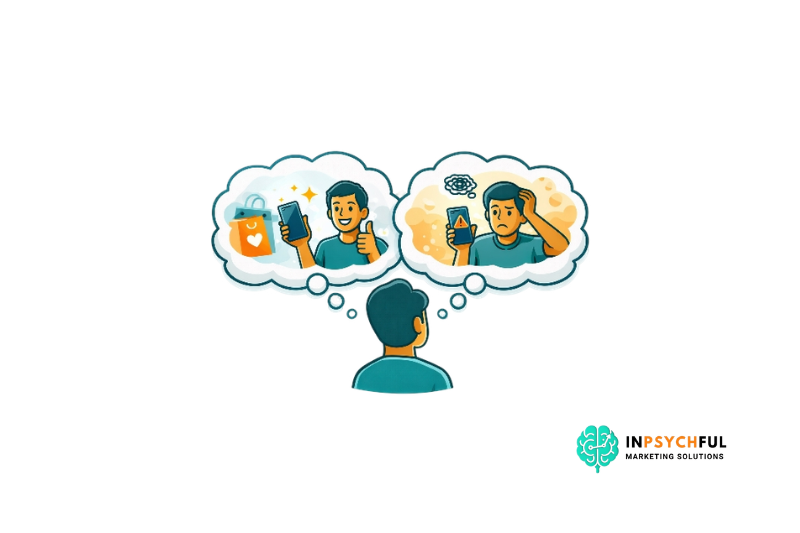
The Peak-End Rule is a psychological heuristic in which people judge an experience largely based on how they felt at its peak (its most intense point) and at its end, rather than the total sum or average of every moment of the experience (Kahneman et al., 1993).
This suggests that a consumer’s memory of a brand is not a video recording of the entire journey, but a “snapshot” of the most emotional and final moments.
The Mechanism of Retrospective Evaluation
The human brain does not possess the cognitive bandwidth to store every second of an experience.
Instead, it relies on Snapshots to form a retrospective evaluation.
This process is governed by the Duration Neglect phenomenon, where the actual length of an experience has almost no impact on how a person remembers it (Fredrickson & Kahneman, 1993).
According to Daniel Kahneman’s research, the “Calculating Self” (the person living the moment) and the “Remembering Self” (the person recalling it) often disagree.
The Remembering Self focuses exclusively on the emotional intensity of the Peak (whether positive or negative) and the finality of the End.
If the end of a transaction is frustrating, the entire experience is encoded as negative, regardless of how pleasant the beginning was.
The Power of the “Peak”
A “Peak” is the moment of highest emotional arousal during a customer journey.
In a marketing funnel, this might be the moment of a successful purchase or the realization of a product’s value.
In a live event, it is often the “Keynote” or the “Big Reveal.”
Emotional Salience: Intense emotions trigger the release of Dopamine and Norepinephrine, which act as chemical “markers” for memory consolidation (McGaugh, 2000).
The Contrast Effect: A single high-intensity positive peak can “mask” multiple minor negative friction points. This is why a brand with a stellar product “Aha! moment” can often survive a mediocre onboarding process.
The Strategic Importance of the “End”
The final moments of an interaction are the most susceptible to the Recency Effect.
This is a cognitive bias where items or experiences at the end of a sequence are remembered more clearly than those in the middle (Baddeley & Hitch, 1974).
Closing the Loop: In 2026, “Post-Purchase Support” is the new “End.” If a customer completes a purchase but the confirmation page is broken or the follow-up email is cold, the brand’s memory “snapshot” is corrupted.
The “Final Gift” Strategy: Many high-end hotels and restaurants use a “Parting Gift” or a personalized “Thank You” to ensure the final data point in the consumer’s brain is positive. This effectively “rewrites” any minor inconveniences that may have occurred during the stay.
Operational Applications of the Peak-End Rule
To build an unforgettable brand, organizations must shift from “Average Quality” to “Peak-Focused” design:
Identify and Engineer the Peak: Map the user journey to find the moment of highest potential value. Invest resources to ensure this moment is emotionally resonant and frictionless.
Optimize the “Off-Boarding”: The end of a subscription, a service, or an event must be as smooth as the beginning. Frustrating “Cancellation Loops” or poor exits create a negative final snapshot that destroys the chance for future referrals.
Manage the “Troughs”: While a peak can mask small errors, a “Negative Peak” (a major failure) can overwrite everything else. Operations must focus on “Error Recovery” to ensure a negative peak is immediately followed by a positive resolution, effectively shifting the memory.
Memories are not objective records; they are edited highlights.
By prioritizing the peak and the end of the customer journey, brands can influence the “Remembering Self” of their audience.
In a competitive economy, it is not the brand with the most “average” satisfaction that wins, but the brand that creates the most intense positive snapshots.
References
Baddeley, A. D., & Hitch, G. (1974). Working memory. Psychology of Learning and Motivation, 8, 47, 89.
Fredrickson, B. L., & Kahneman, D. (1993). Duration neglect in retrospective evaluations of affective episodes. Journal of Personality and Social Psychology, 65(1), 45.
Kahneman, D., Fredrickson, B. L., Schreiber, C. A., & Redelmeier, D. A. (1993). When more pain is preferred to less: Adding a better end. Psychological Science, 4(6), 401, 405.
McGaugh, J. L. (2000). Memory: A century of consolidation. Science, 287(5451), 248, 251.