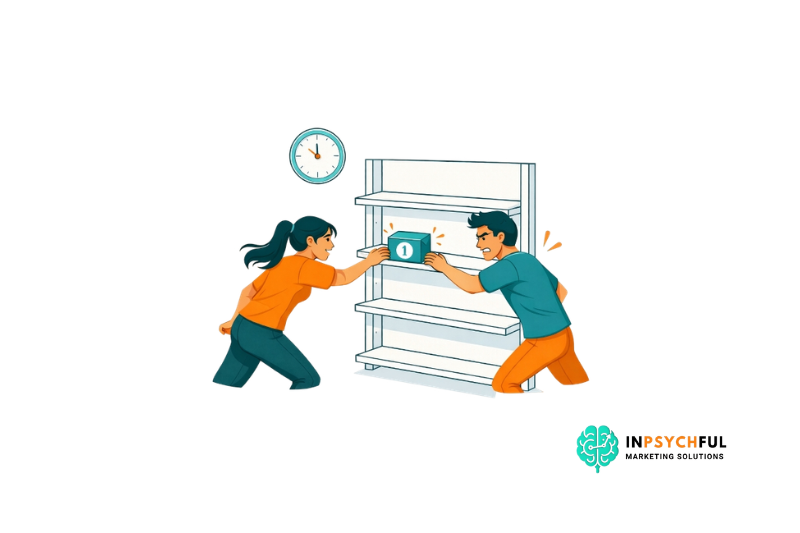
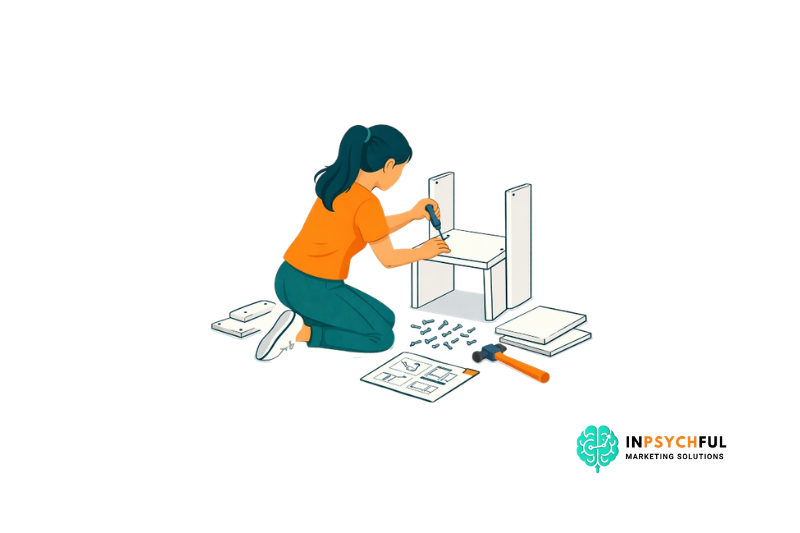
The IKEA Effect is a cognitive bias in which consumers place a disproportionately high value on products they partially created or assembled themselves (Norton et al., 2012).
This phenomenon suggests that labor leads to love. When an individual invests effort into a task, the successful completion of that task triggers a sense of Psychological Ownership and competence, making the final result feel more valuable than a pre-assembled alternative.
The Mechanics of Labor and Value
Traditional economic models assume that labor is a “cost” that consumers want to minimize.
However, behavioral research indicates that under specific conditions, labor acts as a “value-adder.”
According to Norton, Mochon, and Ariely (2012), the key to the IKEA Effect is Successful Completion. If the task is too difficult and the individual fails to finish it, the effect disappears.
But when the task is manageable, the effort invested is transformed into a feeling of “Effective Motivation.” This is the human need to feel like a competent agent capable of affecting the environment (Bandura, 1977).
Psychological Ownership: The “Mine” Heuristic
When a consumer participates in the creation of a product or a service, the boundary between the “Self” and the “Object” begins to blur.
This leads to Psychological Ownership.
This is a state where an individual feels as though the target of ownership is “theirs,” regardless of legal title (Pierce et al., 2003).
The Endowment Effect: Once a person feels ownership over an item, they value it significantly more than an identical item they do not own (Kahneman et al., 1991).
The Self-Reference Effect: Information and objects related to the self are processed more deeply and remembered more clearly. By building the product, the consumer “references” themselves within the item, anchoring it in their identity.
The “Labor-Lite” Strategy in Operations
Modern operations use the IKEA Effect to increase customer retention and reduce the perceived cost of a service.
By giving the customer a small, manageable role in the process, brands can increase the “Stickiness” of their product:
Customization as Creation: Allowing a user to choose their own dashboard colors, layout, or features in a software onboarding process creates a sense of “build.” This makes the user less likely to churn because they have invested personal effort into the setup.
The “High-Touch” Onboarding: Instead of a “Done-For-You” service, many successful agencies use a “Done-With-You” model. When a client helps draft the initial strategy or contributes to the creative brief, they are more likely to support the final result because they feel a sense of authorship over the work.
The Built-In Feedback Loop: Asking for user input during the development of a product or service (Beta testing) leverages the IKEA Effect. The users feel they helped “build” the brand, leading to high levels of advocacy and “Superfandom.”
The Limit of the Effect: The Effort-Reward Balance
There is a “tipping point” where labor stops being a value-adder and becomes a deterrent. This is related to Cognitive Load Theory (Sweller, 1988). If the “assembly” required is too complex or the instructions are unclear, the user experiences frustration and a sense of incompetence.
For the IKEA Effect to work, the “Labor” must be:
Low Complexity: The task should be easy to understand.
High Visibility: The user must be able to see the progress they are making.
Guaranteed Success: The process must be designed so that failure is almost impossible.
Effort is not always a negative variable.
When managed strategically, labor creates a psychological bond between the consumer and the product.
By inviting users to participate in the “build,” brands can move beyond being a mere service provider and become a platform for the consumer’s own sense of competence and identity.
References
Bandura, A. (1977). Self-efficacy: Toward a unifying theory of behavioral change. Psychological Review, 84(2), 191.
Kahneman, D., Knetsch, J. L., & Thaler, R. H. (1991). Anomalies: The endowment effect, loss aversion, and status quo bias. Journal of Economic Perspectives, 5(1), 193, 206.
Norton, M. I., Mochon, D., & Ariely, D. (2012). The IKEA effect: When labor leads to love. Journal of Consumer Psychology, 22(3), 453, 460.
Pierce, J. L., Kostova, T., & Dirks, K. T. (2003). The state of psychological ownership: Integrating and extending a theoretical framework. Review of General Psychology, 7(1), 84, 107.
Sweller, J. (1988). Cognitive load during problem solving: Effects on learning. Cognitive Science, 12(2), 257, 285.