
Quick Answer:
Friction is any variable in a user interface that slows down or prevents a person from completing a task.
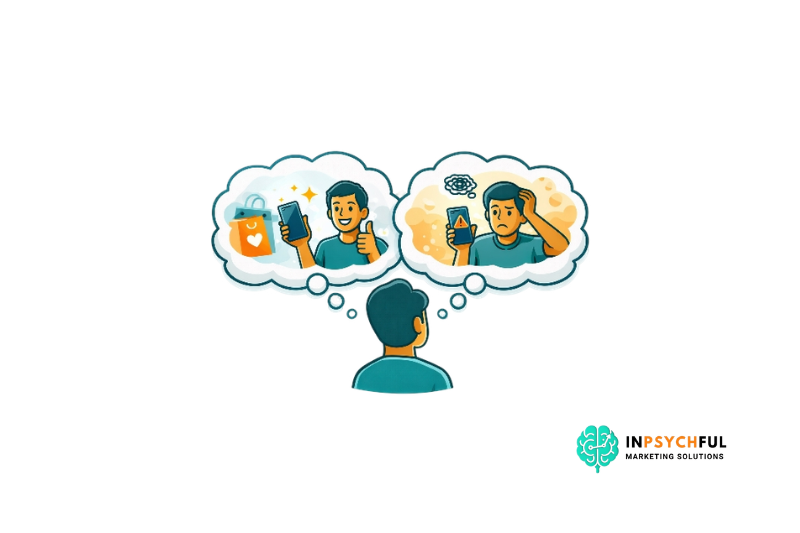
In behavioral science, friction increases Cognitive Load, which triggers the brain’s analytical system to question the necessity of a purchase (Sweller, 1988).
Amazon’s “1-Click” ordering is a masterclass in reducing this load.
By removing the physical steps of data entry, it maintains the consumer’s emotional momentum and bypasses the “Pain of Paying” (Prelec & Loewenstein, 1998).
The “Pain of Paying” and the Striatum
Neurological studies indicate that the act of spending money activates the insula.
This is the same region of the brain associated with experiencing physical pain (Rick et al., 2008).
When a consumer has to manually enter credit card details or navigate multiple shipping screens, they are repeatedly reminded of the “loss” of their resources.
Friction as a Wake-Up Call: Every extra click acts as a “speed bump” that shifts the brain from System 1 (intuitive, emotional) to System 2 (analytical, slow) (Kahneman, 2011).
The 1-Click Solution: By consolidating the entire transaction into a single physical gesture, Amazon minimizes the activation of the insula. The purchase happens so fast that the brain’s analytical “checks and balances” do not have time to intervene.
The Goal Gradient Hypothesis: Momentum in the Funnel
The Goal Gradient Hypothesis suggests that the closer an individual is to a reward, the faster they work to achieve it (Hull, 1932).
In a standard e-commerce funnel, a long checkout process makes the “goal” of owning the product feel distant.
Shortening the Distance: 1-Click ordering essentially moves the “finish line” to the very first interaction. When the goal is only one click away, the psychological motivation to complete the action is at its absolute peak (Kivetz et al., 2006).
Friction and Abandonment: Research shows that 17% of shoppers abandon their carts specifically because the checkout process was too long or complicated. This is a direct result of the “gradient” being too steep for the perceived reward.
Cognitive Ease and the Path of Least Resistance
The brain is a cognitive miser. It will always choose the path that requires the least amount of mental energy. This is known as the Principle of Least Effort (Zipf, 1949).
Fluency and Trust: Interfaces that are “easy” to navigate create a state of Cognitive Ease. This state is associated with positive affect and higher levels of trust (Reber et al., 2004).
Friction as Distrust: When a website is difficult to use, it creates Cognitive Strain. The brain interprets this strain as a signal that the environment is “unsafe” or “complex,” which leads to skepticism regarding the brand’s actual value.
Applying the Science of Friction to Operations
Reducing friction is not just for e-commerce giants. Any organizational system can be optimized by removing “low-value” obstacles:
Defaults are Destiny: Research on Status Quo Bias shows that people are significantly more likely to stick with a pre-selected option than to choose a new one (Samuelson & Zeckhauser, 1988). Setting “opt-out” defaults for renewals or newsletter signups is a powerful way to leverage friction-free behavior.
The Rule of Three: Every additional step beyond three clicks in a digital process leads to a significant drop in user retention.
Visual Saliency: Use design to make the “next step” the most visually obvious element on the page. This reduces the Visual Search Load, allowing the user to navigate the funnel with zero mental effort.
The Bottom Line
Amazon did not win simply because they had more products.
They won because they understood that the human brain is evolutionarily wired to avoid effort.
By removing the “Pain of Paying” and leveraging the Goal Gradient Hypothesis, they turned a complex financial transaction into a frictionless emotional impulse.
References
Hull, C. L. (1932). The goal gradient hypothesis and maze learning. Psychological Review, 39(1), 25, 43.
Kahneman, D. (2011). Thinking, Fast and Slow. Farrar, Straus and Giroux.
Kivetz, R., Urminsky, O., & Zheng, Y. (2006). The goal-gradient hypothesis resurrected: Purchase acceleration, illusionary goal progress, and social-gift justification. Journal of Marketing Research, 43(1), 39, 58.
Prelec, D., & Loewenstein, G. (1998). The red and the black: Mental accounting of savings and debt. Marketing Science, 17(1), 4, 28.
Rick, S. I., Cyder, B., & Loewenstein, G. (2008). Tightwads and spendthrifts. Journal of Consumer Research, 34(6), 767, 782.
Sweller, J. (1988). Cognitive load during problem solving: Effects on learning. Cognitive Science, 12(2), 257, 285.
Zipf, G. K. (1949). Human behavior and the principle of least effort. Addison-Wesley.