Quick Answer:
Collective Effervescence is a concept introduced by sociologist Émile Durkheim to describe the sense of unity and shared emotional energy experienced by individuals participating in a group ritual or live event (Durkheim, 1912).
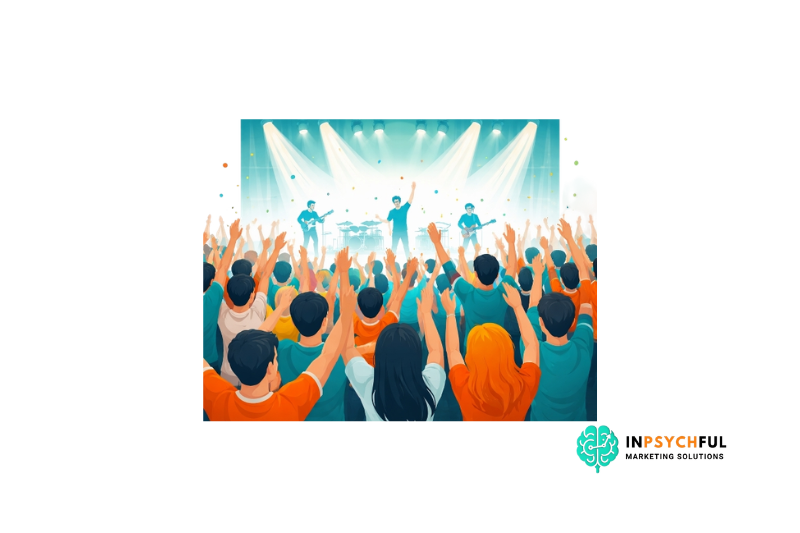
In modern contexts, such as professional sports, concerts, or musical theater, this phenomenon explains the “high” attendees feel when their individual identity merges with a larger crowd, synchronized by a shared focus.
The Neurobiology of the Crowd
The “high” experienced during a live event is a measurable physiological state.
When individuals gather for a shared purpose, their heart rates and breathing patterns often synchronize (Konvalinka et al., 2011).
This biological entrainment creates a powerful sense of social cohesion.
From a neuropsychological perspective, live events trigger a massive release of endorphins and oxytocin.
Oxytocin, often referred to as the “bonding hormone,” facilitates trust and group attachment, while endorphins provide the physical “rush” associated with the collective cheering at a volleyball match or the standing ovation at a theater production (Tarr et al., 2014).
Why Live Events Outperform Digital Experiences
While digital streaming offers convenience, it often fails to trigger Collective Effervescence. The physical presence of others acts as a “social multiplier” for emotion.
Emotional Contagion: Humans possess “mirror neurons” that cause them to subconsciously mimic the emotions of those around them (Iacoboni, 2009). In a stadium or theater, the excitement of one person can rapidly ripple through thousands, amplifying the intensity of the experience beyond what is possible in isolation.
Shared Attention: The psychological value of an event increases when an individual knows that thousands of others are witnessing the exact same “unrepeatable” moment. This creates a sense of “historical significance” that reinforces brand loyalty for sports teams and artists.
The Role of Ritual and Synchronization
Rituals are the “delivery systems” for collective effervescence.
Whether it is a specific chant in a Formula 1 grandstand or the synchronized silence before a curtain rises in a theater, these rituals serve to focus the group’s attention (Durkheim, 1912).
For event organizers and marketers, understanding these rituals is the key to retention.
When a fan participates in a ritual, they are not just watching a game. They are reaffirming their membership in a tribe.
This shared identity is a more powerful predictor of long-term loyalty than the actual outcome of the event or the quality of the venue.
Strategic Applications for Event Operations
Understanding the psychology of the crowd allows for better operational design.
Designing for Shared Moments: Modern stadiums and theaters are increasingly designed to facilitate social interaction and “sightlines” of other fans, not just the stage or court. Seeing the reaction of the crowd is as vital to the experience as seeing the event itself.
The Pre-Event “Prime”: Using music, lighting, and communal activities before the main event begins helps to synchronize the crowd’s emotional state, ensuring that the “Collective Effervescence” hits its peak at the right moment.
Post-Event Integration: Because the “come down” from such a high emotional state can be jarring, successful event brands provide “cool down” rituals or digital communities where fans can continue to share the emotional energy after they leave the physical space.
The Bottom Line
Live experiences thrive because they fulfill a fundamental human need for connection and shared meaning.
Collective Effervescence is the invisible engine behind sold-out stadiums and packed theaters.
By focusing on the psychological synchronization of the crowd, brands can move beyond “ticket sales” and begin building lifelong communities.
References
Durkheim, É. (1912). The Elementary Forms of Religious Life. George Allen & Unwin.
Iacoboni, M. (2009). Imitation, empathy, and mirror neurons. Annual Review of Psychology, 60, 653, 670.
Konvalinka, I., Xygalatas, D., Bulbulia, J., Schjødt, U., Jegindø, E. M., Wallot, S., … & Roepstorff, A. (2011). Synchronized arousal between performers and highly-related observers in a fire-walking ritual. Proceedings of the National Academy of Sciences, 108(20), 8514, 8519.
Tarr, B., Launay, J., & Dunbar, R. I. (2014). Music and social bonding: Self-other merging and neurohormonal mechanisms. Frontiers in Psychology, 5, 1096.